Saturday August 10 and Sunday August 11
Saturday evening’s train ride was on the Royal Livingstone Express and included dinner and way too much wine, but it lent itself to wonderful stories out of the mouths of Al, his brother John and their old childhood friend, Larry. (No luggage yet). Proof yet again that my mother-in-law was a saint.
The dinner train is a restored steam train and is a small part of the “Cape to Cairo” train vision in the late 1800’s that would join all the British colonies in Africa north to south. It was never completed for a variety of reasons, including the French and Portuguese having idea of their own to cross the continent east-west. The train line now goes from Cape Town to Dar Es Salaam in Tanzania. Nothing I love more than a restored train car and this was no exception. A good time was had by all.
No worries. We didn’t have to get going until 10 a.m. the next day. Oh wait, we signed up for an extra safari run through Mosi oa Tunya National Park to see if we could see some critters, which meant a 6:30 a.m. jump start. We saw more birds than anything but as I will soon explain, it seems like every time we head out we see more and more big game. This was a nice introduction to the many species of birds we will encounter and to learn lots of little facts.
Please note I took notes on this when listening to our guides. I don’t carry this info around in my brain from school nor do I plagiarize, so if I get some of the facts wrong, blame it on thick accents of the guides or iphone autocorrect that changed my notes into something unintelligible. I’m trying to multitask after all – taking notes, taking photos and staying in the moment by not doing too much of the former. So here are some facts:
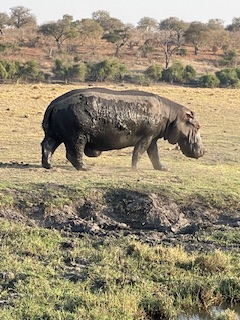
Hippos kill more people than any animal in Africa except for mosquitoes. My son, Joe, introduced me to the term “murder horses” and I guess they are. How can something with such cute nostrils and ears be so dangerous?
Baobab trees are called “upside down” trees because they are very skinny at the bottom and without leaves their branches look like roots, as if they’ve been planted upside down. Even with leaves you can see this. Elephants eat baobab especially for the moisture they provide.
Their favorite tree to eat, though, is the mopane (moh PAH nee) and what a clever little tree it is. The elephants start to eat it and in an effort to avoid being wiped off the face of the earth by ravenous elephants, the tree produces extra tannins which race to the leaves and the elephants suddenly are left wondering why they thought these were a delicious thing to eat a few minutes ago. This is one of the reasons elephants rip the branch totally off before starting to eat. It’s a game of cat and mouse for sure!
Elephants eventually lose their teeth when they get old as they get ground down from eating and then they starve to death. That’s pretty depressing, huh? African Elephants live to about 60-70. Before they are 40 they get a few sets of teeth and so, we were told, the younger elephants eat with reckless abandon, not caring if they are grinding rocks along with the grass. After they are 40 they are noted to be a little more careful with their chewing. Kids.
I was sorry to learn that although mopane worms are a delicacy which have three times the protein as beef and chicken, it is unlikely they will be on our menu; it is more commonly served in Namibia and we won’t be there. I’m always game to try weird new food (hey, haggis is delicious depending on the recipe). Except beets and brussel sprouts. Save your breath on how they are both delicious when cooked blah blah blah.
One bird we saw, the ground hornbill – you may have to look most of these up if you want photos, it is extremely hard to photograph most birds with my iphone – likes to eat snakes. If you look at the photo (I’ll see if I have anything) it has a red wattle-like thing on its neck which it used to attract snakes – which it then eats.
Saw egyptian geese, egrets, white backed vultures.
Giraffes have high blood pressure because of those long necks. They can’t have their heads down for too long which is why they eat from the tops of trees. (Whose idea was this anyway?) Giraffes are my favorite animal, but I never knew that they sleep standing up and can only sleep 7 mins at a time, and for fourteen minutes twice a day. If their heads nodded down like ours do on a long plane ride, they would die because the blood couldn’t get to their heads. Or something along those lines. Suffice to say they are my favorite animal but we clearly have nothing in common as 14 HOURS of sleep would be my preference. Lying down, too.
Our last stop on this morning safari was to see the white rhinos. Nine of them. There are eleven in ALL of Zambia. They are not white and actually the name comes from a misunderstanding somewhere along the line, when they were called “wide rhinos” because of their wide mouths. These were sleeping happily, farting and snorting in greeting, and are guarded 24/7. As the ranger on guard told me “if they weren’t, they’d be gone”. This was the only time we were allowed out of the jeep for a short walk to see them. It felt very special to be able to see these endangered animals, and also to know that in Kruger National Park the Black Mambas are on patrol – look it up, these are some mad-as-hell-and-not-going-to-take-it-anymore women who will happily shoot a poacher on sight. Well, maybe not, but the poachers can’t be sure of that now, can they?
Back to the hotel to pack up. We had to put our extra shoes (in our case just our sandals) in plastic bags. We would be leaving Zambia to go to Botswana where the soles of our footwear would be disinfected (we had to do this before seeing penguins in the Falkland Islands, too) – this time for mad cow disease. John and Larry didn’t have to do this as they still don’t have luggage. It is expected today.
Hopped on a bus and headed across the Kazungula Bridge which only opened in 2021. Before that everything had to be ferried across the Zambezi or Chobe River (depending on which direction you’re looking) and trucks could wait for weeks to cross. This made the area quite unsavory with much prostitution and general debauchery. The bridge curves markedly, as does the railroad track in the middle of the bridge. Here again I am going to have to direct you do research this further if you like, because it has something to do with four countries sort of meeting except for 400 or so feet, a war in 1970 to hash it all out and who knows what all else. But curve it does.
The Zambia/Botswana entry point is a huge, new building, unlike the hot stuffy Humphrey Bogart-esque offices of the Zim/Zam border crossing. You walk in and veer right to stamp out of Zambia, then walk across a large hall to stamp into Botswana. Then you leave the hall and disinfect your feet and shoes that are in the plastic bag. But not John and Larry. Oh? I said that already? Imagine how sick THEY are of not having luggage!
We said goodbye to our Zambian bus driver and squished into two small vans for the short ride to our hotel. Quick lunch and then onto a boat for our first view of the (now Chobe River) and Chobe National Park. Not to be outdone by all the other international conflicts about borders, Namibia and Botswana had to got the the International Court in the Netherlands to settle who owned what part of the channels on either side of the island whose name escapes me now. Botswana won for reasons I don’t remember either but now it’s all part of Chobe National Park Botswana.
This is where our trip started to get real. I know you’ve been waiting for this but so were we. A couple of lazy hippos in the water. Not sure if I mentioned they stay in the water all day and only come out as the sun goes down – otherwise their skin can’t handle it. Also fun fact, they are so massive they cannot copulate on land and have to do it in the water where they are more “buoyant”. I don’t know why this isn’t true for elephants and rhinos and whatever, but there you are.
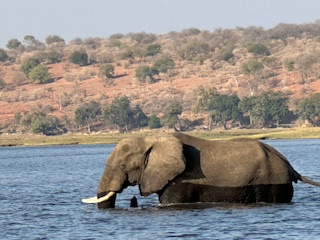
We saw cape buffalo, mostly males. Just an FYI, a cape buffalo will be happy to chase you up a tree, and will patiently wait there until you decided to come down. Do not mess with a cape buffalo. Saw lots of elephants. They are unbelieveably massive. The males hang out mostly by themselves, but the females, led by a matriarch who knows where to find food, hang out together. We were VERY fortunate to watch all of them cross the river. The huge male, followed by a juvenile male, was able to walk across as were the grown females, but the babes looked like they were swimming for dear life. When they started to finally walk up the bank on the island, one of the babes flopped itself back into the water like it was glad to be alive! A juvenile male had followed them across and was not thwarted by the grown female who took up the rear of the parade, but once on land again she shooed him away with a great elephant trumpet. Felt kinda sorry for him. He’s only a teenager after all….
A ridiculous amount of birds are everywhere and I wish I could photograph every one of them. African Jacanas with chestnut rumps and white and black heads that are locally known as “Jesus birds” because they can walk across lily pads as if they are walking on water. Black herons, African spoonbills, huge Maribou storks, Southern Red Billed Hornbill (“flying peppers” as opposed to “flying bananas”, yellow billed hornbills). I find the helmeted guinea fowl, although ridiculously common that the guides don’t even pay any attention, quite colorful and beguiling. Hoping to get a nice photo before this is all over.
Our boat ride ended with another African sunset and it’s a good thing because I took more photos of elephants than a person should ever take.
So thus far we have seen three of the Big 5 – elephants, rhinos, African cape buffalo. Will we see lions and leopards? Who knows, I hope so!
We had dinner and went to our rooms, not allowed to walk back from restaurant that was a five minute walk because – well, the National Park is an open park. I was shocked when I went to set my alarm for the 5 am wakeup and thought my phone was wrong. It was only 8:30 pm and felt like 11 pm. Full days, these land tours. No rest for the wicked.
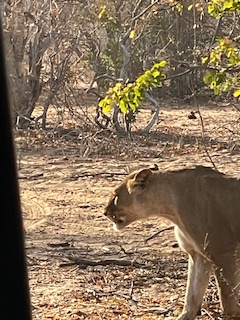
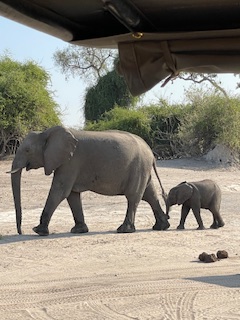
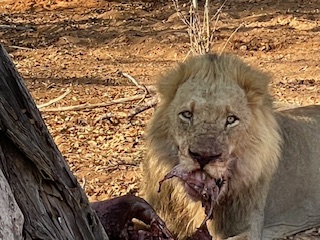
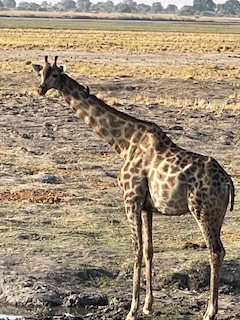
It is now time to leave Chobe National Park. I was hoping to get back to this so I could fill in the blanks and add some photos, but yesterday was a full day with a 5 a.m. safari and a 3 p.m. safari. In between I wrote this and never was able to get back to download some photos. Yesterday we saw it all – elephants, giraffed,kudus, more impala (one in pieces as we watched an entire pride of lions feast on it) and more. This morning we are headed to Okavango Delta where we stay in tents and have to be escorted everywhere by guards as we will be IN it. There will be no internet etc so I wanted to get this posted. See you on the other side. I’ll be writing offline and I’m hoping my photos transferred to the laptop from my phone now so I’ll be able to catch up. Here are just a few photos from today to wet your whistle:


 Favorite Philosopher's Blog
You must be logged in to post a comment.