I was rudely awakened by Al this morning telling me it was time to get up, we had to get going. That’s what I get for not doing any of the planning. Our second Loch Ness boat ride was this morning. We went downstairs for breakfast – I just had my usual yogurt, jam, crunchy whatever, in this case some kind of Scottish crisp and a half cup of the crazy strong Scottish coffee. (No one ever asks if you want decaf. As if.) Al had the “sampler” Scottish breakfast, as opposed to the full, and the haggis chef was not in this morning so no haggis.
Off we went to meet our boat. Of course, we knew where we were going – not. The first dock we stopped at (it’s all run by the same company, in our defense) was the wrong one, but allowed me to get some decent photos of the Highland cows which are too cute for words, with their hair hanging in their eyes like a 60’s Brit band. The dock we were supposed to be at was about five minutes down the road and my driving skills have improved to the point that we got there in three.
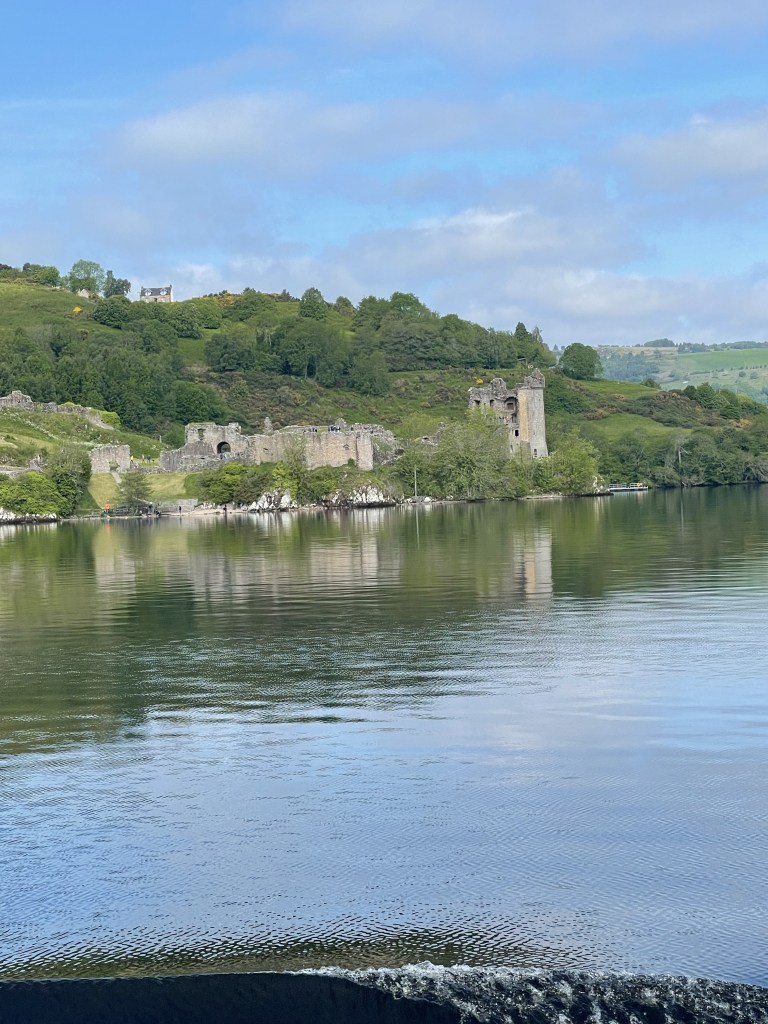
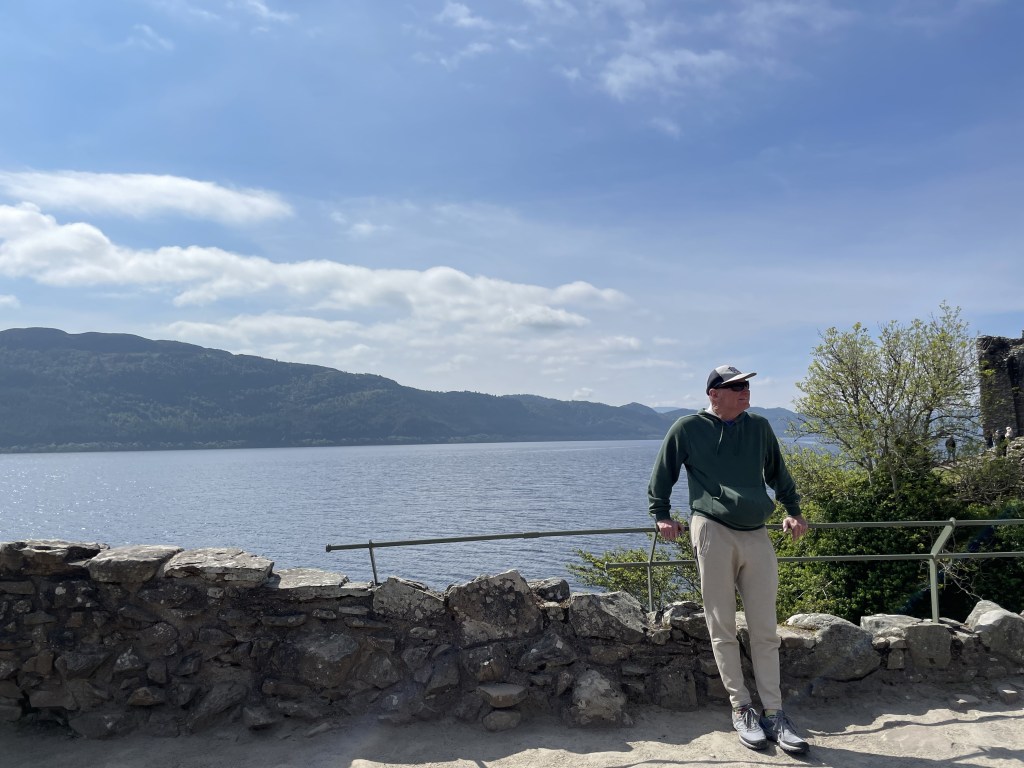
This one was not a fast one but more like a small ferry, with inside seats and upstairs on deck seats. We opted for upstairs – I was happily bundled up and love the wind in my face. The sky was overcast in the morning – what we in California call the “marine layer”. The boat took us down the Loch and damn it was beautiful. Then it stopped at Urquhart Castle. Again, what the heck. The sky opened up and showered us with sunshine for the hour we were there at the castle.
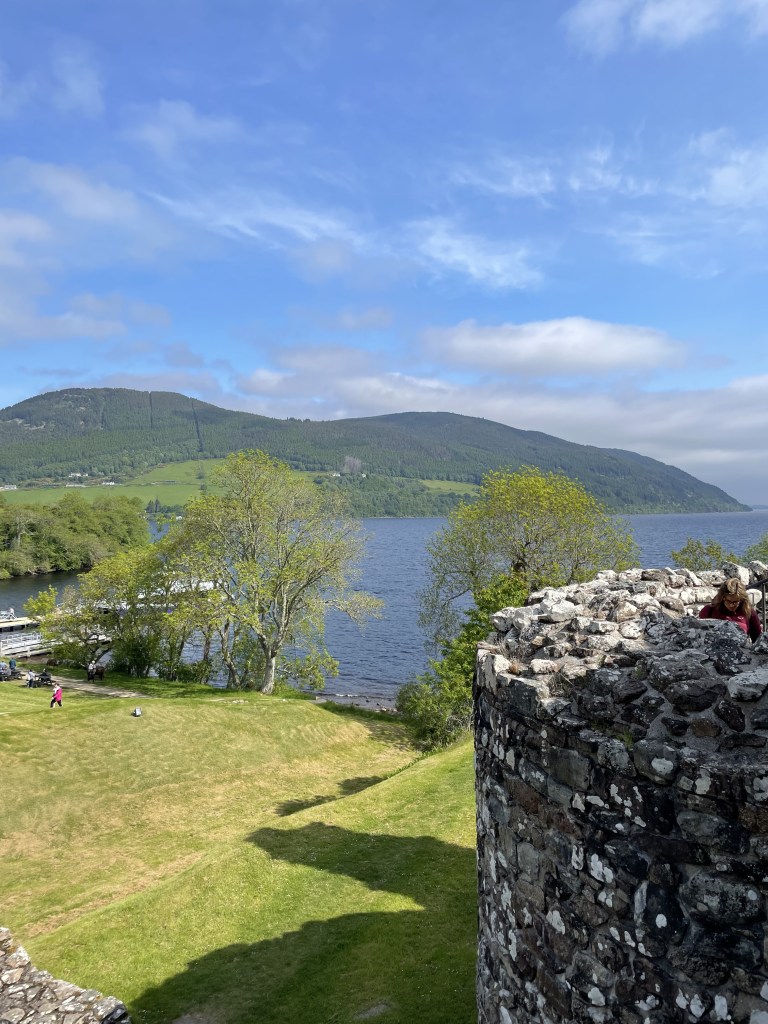
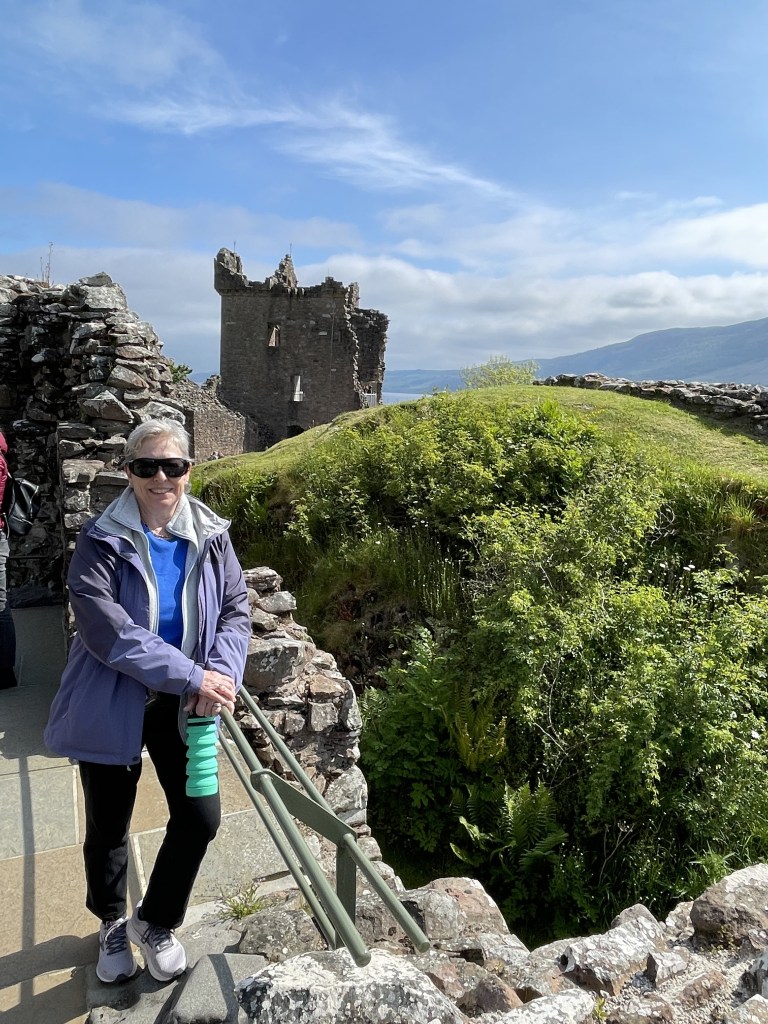
I haven’t yet tired of castles, probably because the history is so fascinating. What strikes me is that the victor (usually the Brits) would destroy as much of the castle as they could, to deter whatever clan king they subdued from trying to cause trouble again. This castle was particularly beautiful to my eyes and I broke my rule of only taking photos with us in them. How many photos can we take with one or the other of us. It does help to keep the number of scenery photos down from 1,572 to more like three or four. People all around me were taking photo after photo after photo and I must say it felt good to know they would be sifting through them all when they got home instead of me.
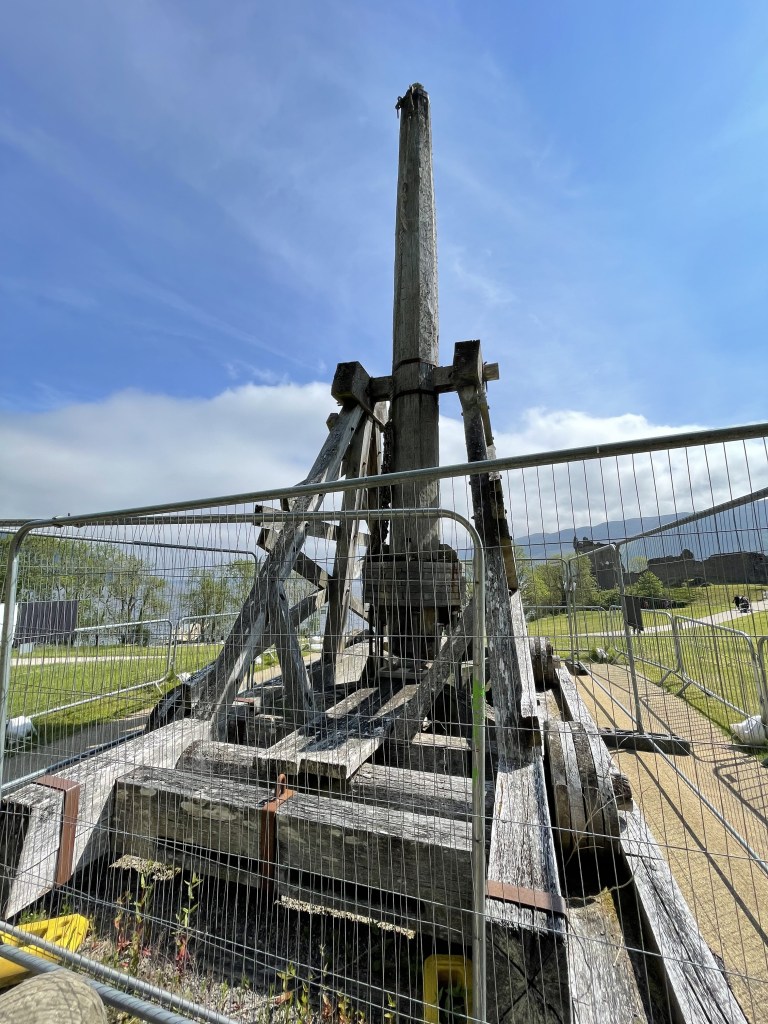
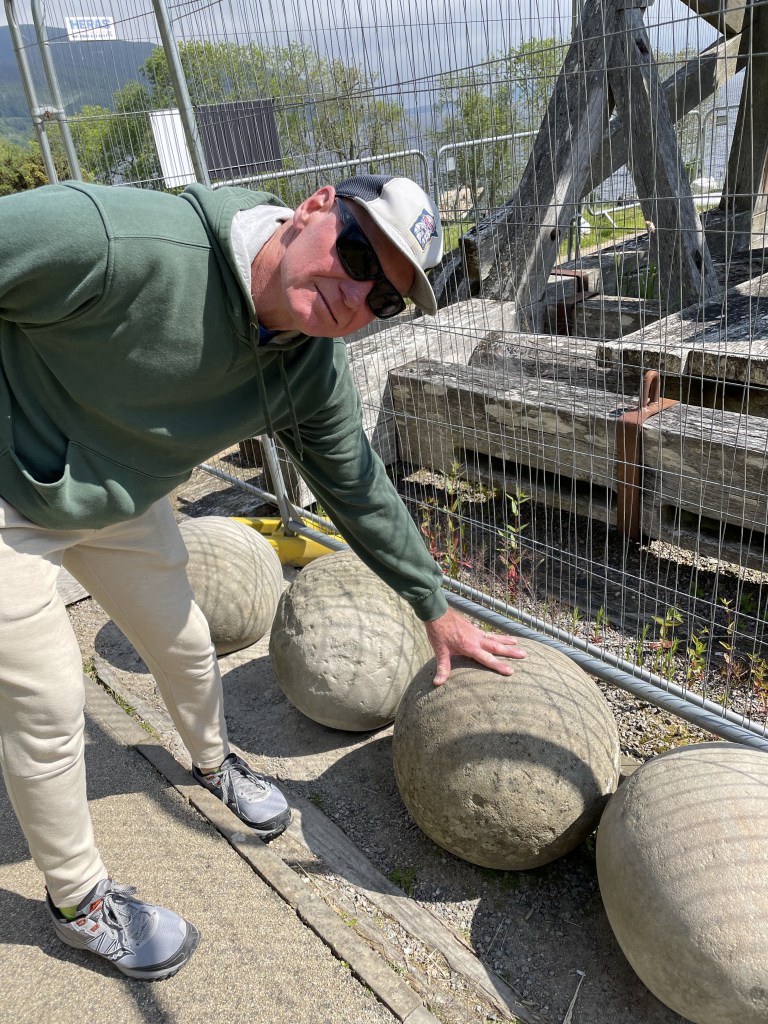
This castle on the gorgeous shores of Loch Ness was incredible. Despite the fact that a previous restoration had consolidated the remaining walls and rooms and in the process eradicated some of the other rooms, thus making it a bit difficult for present day scholars to fully ascertain what went on and how in the life of a castle dweller, it still was fascinating. It did have a kiln for baking tucked away in a cave, a kitchen where you could see the fire area and what looked like a huge stone table, a prison cell (big nope on those). Excavated bones tell us that although there were fish in the Loch, the residents preferred meat. They had also unearthed some HUGE round boulders that were capable of being catapulted over walls at the enemy. They had a replica of a trebuchet– it was part of a movie set some years ago. Still cool to think about though, and size of the boulders it was able to heave a great distance. By the time we took the boat back to the dock the grayness had descended upon us again, but no rain and we have no complaints.
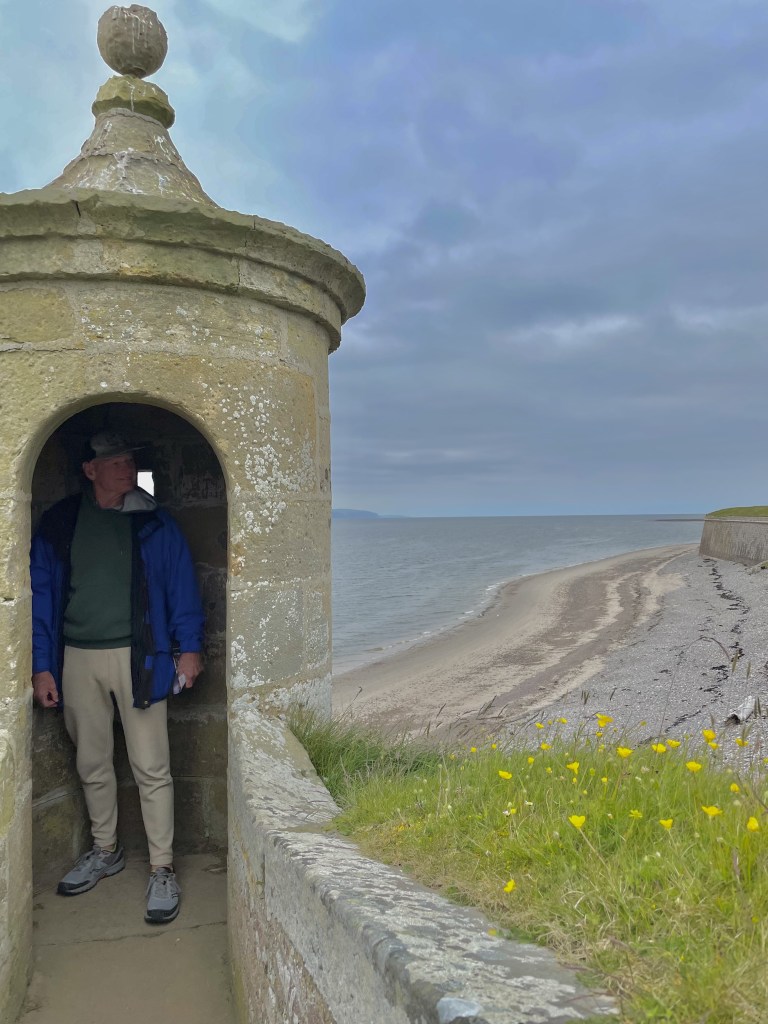
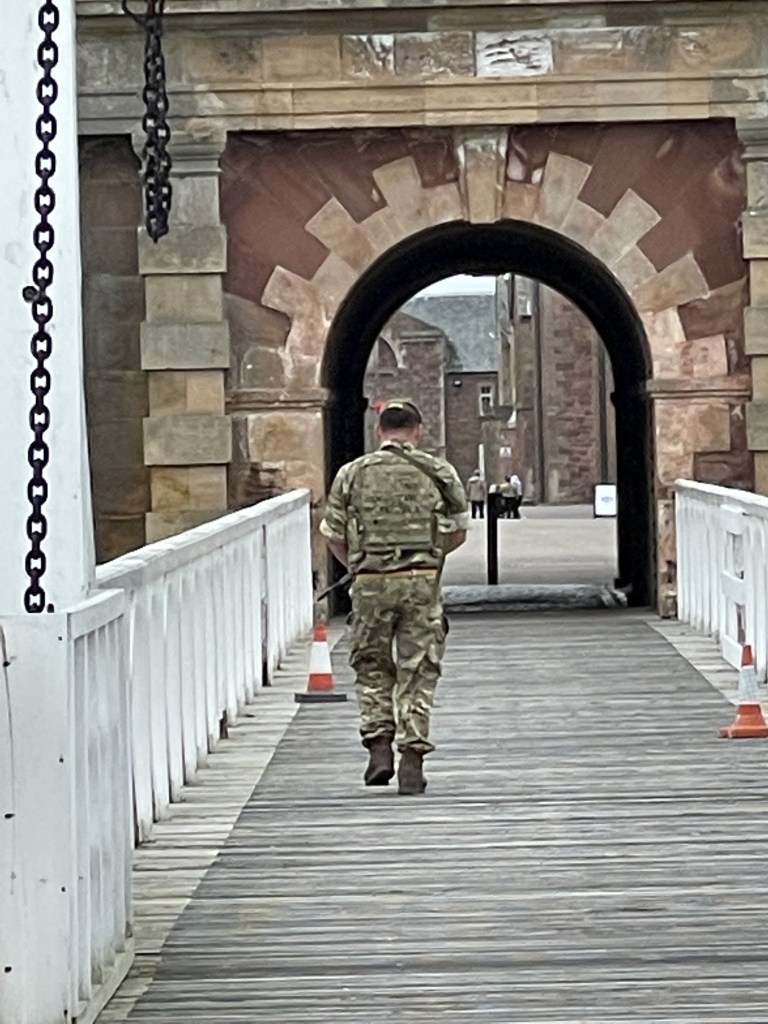
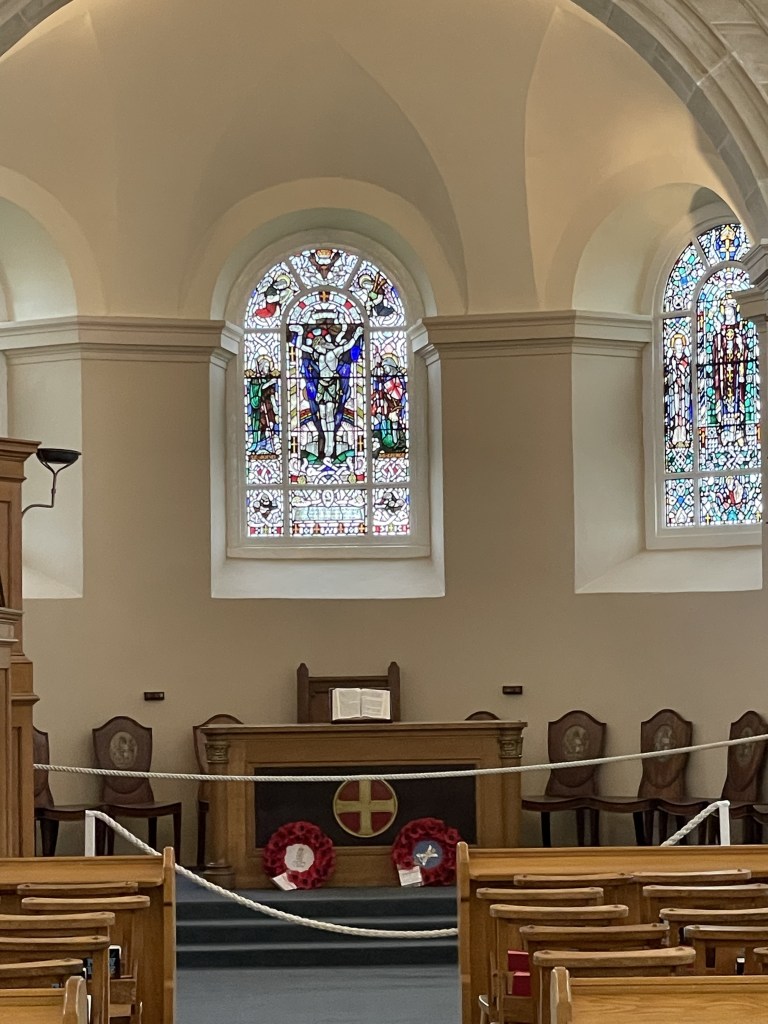
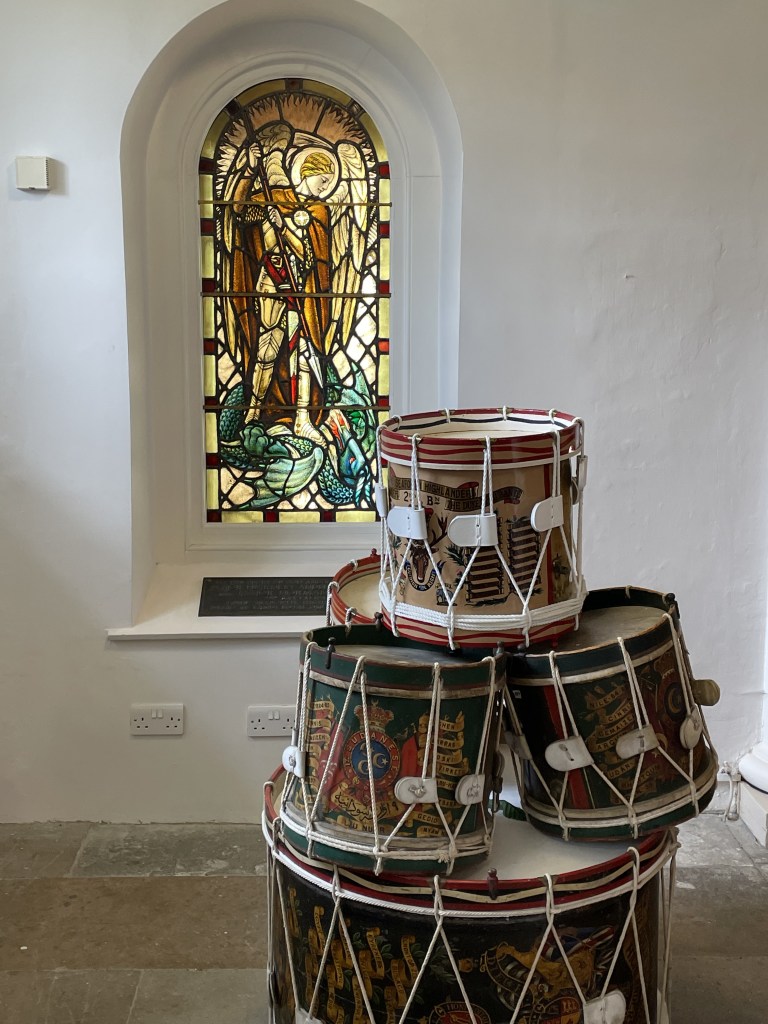
We then found our way to Fort George, which is still an active military base for the Blackwatch Regiment, mostly barracks. (Duh, now I know why it’s called Blackwatch plaid. A seamstress should really know these details). It’s an impressive group of buildings, built in the 1700’s. It’s not a highly popular tourist spot and Al had been advised to check it out by a golfing pal. We roamed around for awhile by ourselves and then went back to the visitor center to join the tour group – which was us. It was delightful as there was the wizened old docent but also a young woman who was the historian. She was shy at first but then opened up when she started to throw historical details in. She even joked that at some point the English just ran out of names and started numbering them, calling them all George or whatever. I KNEW it!
Anyway, it was George II who started building it but there was apparently discord between the architect (who wanted symmetry and some semblance of beauty) and the military (who wanted it to just house a whole bunch of people). Therefore, it took twenty years and by then old George died and George the 3 took over – yeah, THAT George III. It was built after the Jacobites were defeated at Culloden as a military stronghold in order to control the Highlands and is supposedly the largest fortification in all of the UK. Ironically, it has never been attacked.
My knowledge of the history and inability to repeat word for word what a guide tells me is failing me. Because I am again internet challenged this evening and am writing this on Word and can’t google up little details, I’ll have to just move on to the 20th century. It is tucked inside a large bay of the North Sea. A fact that kind of made me inexplicably emotional is that this location is where drills were done to practice for D-Day. The beaches below the cliff are perfect for that purpose. It just shook me for some reason, imagining that scene: preparation for such a monumental and ultimately successful but devastating campaign. It would not be the last time today that I would be overwhelmed with emotion with all the war-war-war. (The guides rolled their eyes as they relayed the truth that the Scots were always involved in some war or another due to their “association” with the UK.)
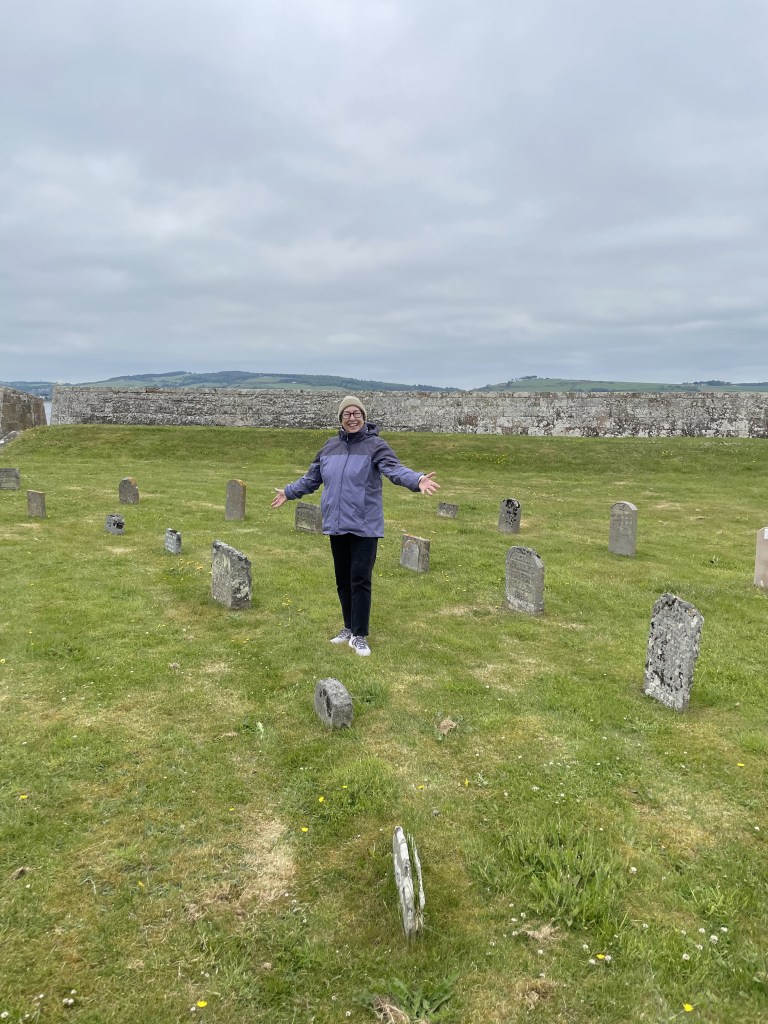
Did I mention the dog cemetery? That was part of our special tour and is not open to the general public without a tour. Most of the rooms of the campus have been renovated to some degree for modern times, but this room is entered through heavy original doors, you walk through the narrow room, maybe 20 feet across, to the other side and through doors that lead out into a courtyard and the bulwark, the beach is very close just beyond – whereas the rest of the fort is elevated above the water, this area is at beach level. The deal was that the people inside could get out to the boats fast if they had to. But if the “bad guys” decided to come in through the seaside door, they would be stopped by another door to get into the main part of the base. Not only that, but in the walls, every few feet on either side were slits through which defenders could shoot at the unwelcome guests. If you looked into those slits you could also see that they were slanted so that the guns were pointed down into the room and the shooters were shielded. Clever, huh? The doorway of the seaward door also sported graffiti from bored soldiers from the 1700’s.
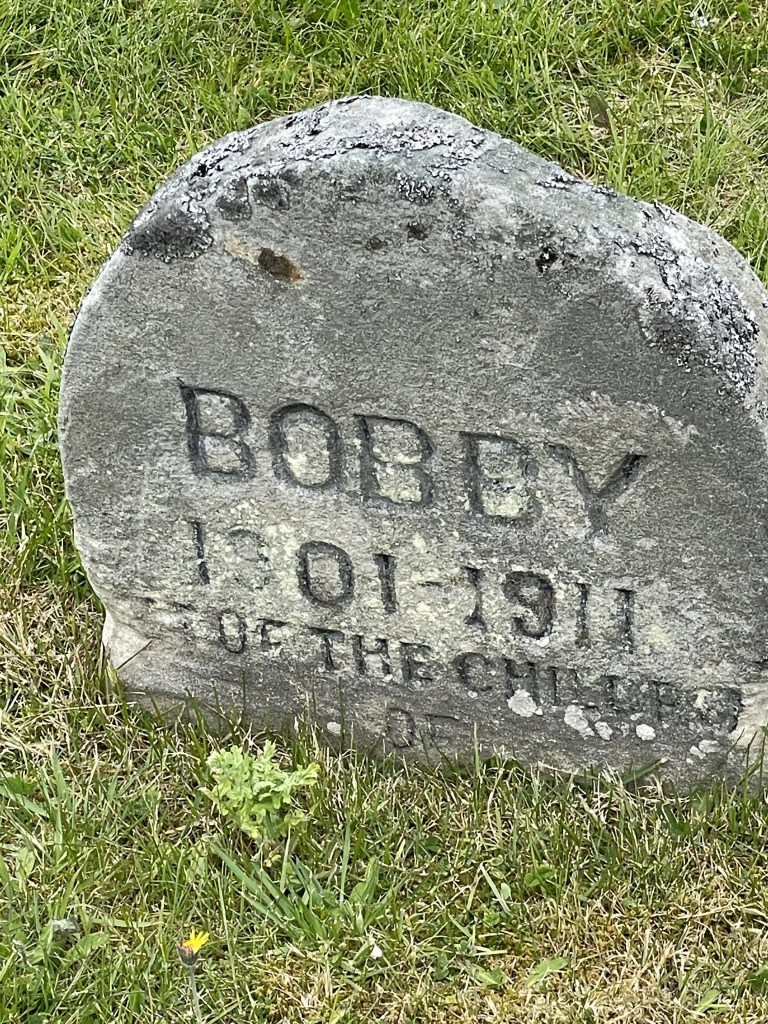
Once outside you see how accessible the beach is, and there on a lovely little hill, is the doggy cemetery. Yes, pooches! The oldest one there is from the time when the Scots were off fighting in Egypt so the stone is shaped like a pyramid. Various and sundry doggies of previous residents are interred there. How adorably Scottish is that, really?
Finally, if we wanted to get to Culloden Battlefield we needed to get scooting. Again, we were too late for the visitor center because of that crazy daylight, but the battlefield is always open. (It is 9:30 p.m. as I write and the sun is not set yet. Up in Skye is was 10:30 before it went to sleep and when I went to bed at midnight it was still just past dusk). This was the second time I was touched by the folly of conflict.
Culloden has become common knowledge among folks who have watched and read Outlander, and we know it from the perspective of the Jacobites, who wanted to reinstate Bonnie Prince Charlie Stuart as the rightful heir of the throne (as opposed to Mary Queen of Scots and William of Orange). The rebellion against the British government had been going on for awhile, and finally at Culloden the government lined up on one side and the Jacobites on the other. It did not end well for the Jacobites and effectively ended their cause. The bonnie prince went into exile.
To stand on the Battlefield is sobering indeed. The sun was partially out for us again but a cold wind swept across the plain. On one side of the battlefield are planted red flags to signify where the government line began, and afar on the other side, blue flags. It is not hard to imagine what went down between those lines of flags and it all happened in the span of an hour or so. Along the trail are markers commemorating each clan and how many members they lost and the name of the leader of the clan. The Jacobites who were killed (upwards of 1500) were buried in mass graves with their clansmen. It is largely unknown where the government fighters were buried – there were only about 50 of them. The Jacobites were quite simply outnumbered.
The Battlefield is a graveyard and it is expected when you visit that you will respect that and in some places even be silent. It is chilling in its simplicity. Fight, die, be buried under our feet forever.
And with that, the Jacobite uprising was over and after that the Highlands population was decimated, either by people fleeing for the Americas or elsewhere, or by clan cleansing by the government. Clan colors were banned, weapons were outlawed, language was discouraged. The clans lost power and land. When you are there in the Highlands, such a spiritual place, it is hard to imagine there was once a whole culture there that for all practical purposes, vanished.
The British government eventually allowed Scottish members of its military to wear their colors in regiments which is why you would recognize some of their uniforms with the kilts and the feathered hats. The descendants keep the memory alive as best they can with a pride that is evident in the museums they have created.
The Highlands are only now in the last few decades becoming more populated but our young guide informed us that like many places, “brain drain” is a problem and the present government is trying to encourage their bright young people to stay. There is also some sentiment that it is time to quit “living in the past” but I can’t think of any group that has a history of being “cleansed” ever forgets…and it doesn’t seem like it is in the nature of this delightful people to forget that it was specifically their families who were targeted. Indeed,
the guide told us that some are beginning to refer to the cleansing as a genocide.
Tomorrow we leave the Highlands for Edinburgh and the wedding! Today I walked 14,400 steps and we never did that city walk, so it’s time for bed.
I leave you with this by Scottish poet Robert Burns: Song – farewell to the Highlands
Farewell to the Highlands, farewell to the North
The birth-place of Valour, the country of Worth;
Wherever I wander, wherever I rove,
The hills of the Highlands for ever I love.





 Favorite Philosopher's Blog
Dear Mary, Karen Glines here. You are a very fine writer who describes so well that I can picture each scene vividly. Thanks for sharing all of this. Love, Karen
>
Thanks Karen. I always feel like. I’m just babbling so glad you are enjoying it!